Although the amazing geometric phenomenon we are about to present is attributed to Napoleon Bonaparte (1769-1821), some critics assert that the theorem was actually discovered by one of the many mathematicians with whom Napoleon liked to interact. Yes, Napoleon took pride in his ability in mathematics. Perhaps this aspect of his values is a good model for us all to follow.
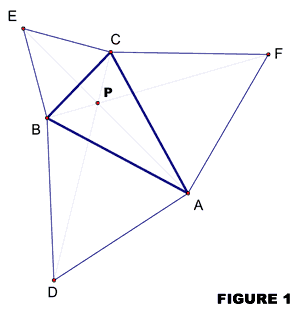
Simply stated, we begin our exploration of this geometric novelty with a scalene triangle — that is, one that has all sides of different lengths. We then draw an equilateral triangle on each of the sides of this triangle. Next, we will draw line segments joining the remote vertex of each equilateral triangle with the opposite vertex of the original triangle. (See Figure 1.)
There are two important properties that evolve here — and not to be taken for granted — namely, the three line segments we just drew are concurrent (that is, they contain a common point) and they are of equal length. Remember, this is true for a randomly selected triangle, which implies it is true for all triangles — that’s the amazing part of this relationship.
Furthermore, of all the infinitely many points in the original scalene triangle, the point of concurrency is the point from which then sum of the distances to the three vertices of the original triangle is the shortest.[1] That is, in figure C, from the point P, the sum of the distances to the vertices A, B and C (that is, PA + PB + PC) is a minimum. Also, the angles formed by the vertices of the original triangle at point P are equal. In figure 1, ∠APB = ∠APC = ∠BPC ( = 120°). This point, P, is called the Fermat point, named after the French mathematician, Pierre de Fermat (1607-1665).
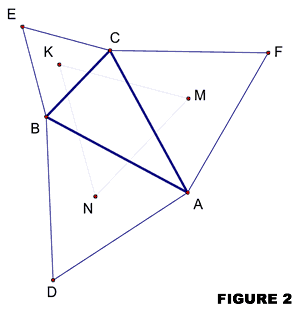
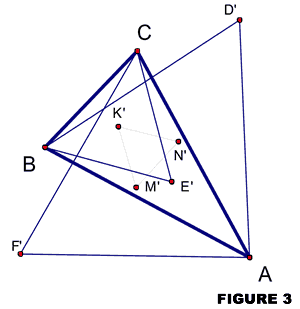
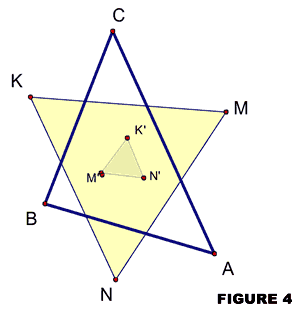
Now to Napoleon’s triangle: When we join the center points of the three equilateral triangles (i.e. the point of intersection of the medians, angle bisectors, and altitudes), we obtain another equilateral triangle — called the outer Napoleon triangle, in figure 2 it is ΔKMN. Remember this is for any triangle ABC. Had the three equilateral triangles — on each side of the scalene triangle – been drawn overlapping the original scalene triangle, then the center points of the three equilateral triangles would still determine an equilateral triangle. This is depicted in figure 3 as ΔK’M’N’. It is called the inner Napoleon triangle. Now something comes up that may a bit hard to picture. Let’s consider the two Napoleon triangles in the same diagram, which can be more easily seen if we omit the generating side-equilateral triangles, as shown in figure 4.
Consider the areas of the three triangles in the figure 4. The difference of the areas of the two Napoleon triangles (the inner and the outer) is equal to the area of the original scalene triangle. Thus, Area ΔKMN – Area ΔK’M’N’ = Area ΔABC.
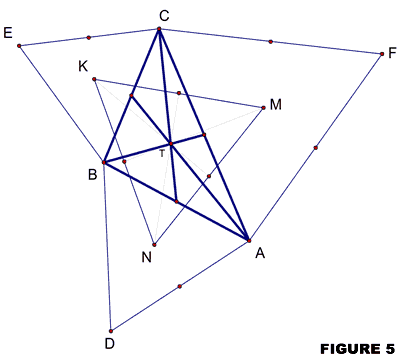
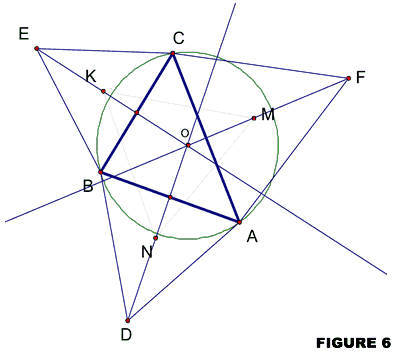
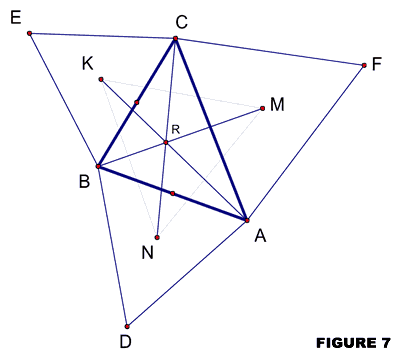
Again, we remind you, that what makes this so spectacular is that it is true for any shape of an original triangle, which we tried to dramatize by using a scalene triangle that does not have any special properties. When we view the original triangle and the Napoleon triangles, they share the same centroid — i.e. the point of intersection of the medians, which is also center of gravity of the triangle. (See figure 5, where we show only the outer Napoleon triangle for clarity, but it is also true for the inner Napoleon triangle.) There are more surprising relationships that can be found on this Napoleon triangle. These were derived long after Napoleon (as he claimed) discovered the very basics of the equilateral triangle that evolved from the random triangle. Take, for example, the lines joining each vertex of the outer Napoleon triangle[2] to the vertex of the corresponding equilateral triangle drawn on the side of the original scalene triangle. First we can show that these three lines are concurrent. That is, DN, EK, and FM meet at the common point O. Second, this point of concurrency, O, is the center of the circumscribed circle of the original triangle. (See Figure 6). Believe it or not, there is even another concurrency in this figure. If we consider the lines joining a vertex of the Napoleon triangle with the remote vertex of the original triangle, we again get a concurrency of the three lines. In figure 7, AK, BM, and CN are just such lines and are concurrent. You may, by this point, get the feeling that just about anytime you have three “related” lines in a triangle, they must be concurrent. Well, to appreciate the concurrencies we have just presented, suffice it to say, concurrencies are not common. They may be considered exceptional when they occur. So that ought to make you really appreciate them! Read more about this and other geometric phenomena in the newly published book: The Secrets of Triangles: A Mathematical Journey By Alfred S. Posamentier and Ingmar Lehmann (Prometheus Books, 2012). -------------------
[1] This is based on a triangle that has no angle greater than 120°. If the triangle has and angle greater than 120°, then the desired point is the vertex of the obtuse angle. [2] We shall use the outer one, just for clarity, but it would hold true for the inner one as well.
With the impasse about teacher evaluation dominating our thinking about education, and the controversy over using test results to determine a good teacher, it might be time to take a step back and consider another way that one of America’s most tested subjects — mathematics — can be more effectively taught.
Let’s take just one example that demonstrates how the subject can be enlivened.
Imagine, as you begin to collect your tax information for 2011, if we still used only Roman numerals. For starters it wouldn’t be 2011. It would be MMXI.
Looks strange, right? Our Hindu-Arabic number system must have looked just as strange 810 years ago when it was first introduced to the Western world by an Italian named Leonardo of Pisa, who was later known as Fibonacci. In 1202, he wrote Liber Abaci, a book of calculations, which introduced the numbers 9, 8, 7, 6, 5, 4, 3, 2, and 1. “With these nine figures,” Fibonacci wrote, “and with the sign 0, which the Arabs call zephyr, any number whatsoever is written.”
Europeans didn’t embrace this strange new idea right away. It took nearly 50 years before other parts of Italy began to accept the base-ten number system. Merchants were suspicious of those who used these clever numbers instead of the more familiar Roman numerals. It wasn’t until more than two centuries later that the use of numerals caught on across Western Europe, about the time the Leaning Tower of Pisa was completed.
This was not Fibonacci’s only — or even most famous — contribution to the world’s body of mathematical knowledge. In chapter 12 of that very same book, he considered the procreation of rabbits. Fibonacci sought to find the number of pairs of rabbits that would result over the course of a year, if a pair required one month to mature and to produce an offspring pair. His calculations of rabbit pairs produced month-by-month led to the sequence: 1, 1, 2, 3, 5, 8, 13, 21, 34, 55, 89, and 144.
This sequence of numbers became known as the Fibonacci numbers — the most ubiquitous numbers in all of mathematics and beyond. We find these numbers in nature — for example the numbers of the three types of spirals on a pineapple are 5, 8 and 13 (Fibonacci numbers). The Fibonacci numbers are also found in the proportions of famous architecture – including the Parthenon, the United Nations building, and the doors of the Cathedral of Chartres. They provide a direct connection to the golden ratio that in itself has a plethora of applications. They even have some practical features: They allow an instant (approximate) conversion of miles into kilometers and the reverse.
Fibonacci explored mathematics at a time when it was not at all a subject to be considered on its own but merely as a tool. We need to infuse his creative and playful spirit into our teaching of mathematics. With children as young as 7, there are puzzles, games, and astonishing relationships that can be brought into the classroom and made an integral part of our teaching of mathematics — taking this important subject out of the realm of “a strange language that must be memorized but not necessarily embraced.” The Fibonacci numbers about which many books have been written (including one by this writer) have boundless applications to enrich mathematics (and beyond) at all academic levels.
All too often, we hear the lament that our children are growing up disliking mathematics — and then, as adults, boasting about how bad they were in the subject all through school. Perhaps our teachers are so often obsessed with preparing students for tests they lose sight of the pleasures and applications that help students to learn about mathematics in different ways. If teachers were to expand their knowledge to the more creative aspects of mathematics, we may instill a more inquisitive spirit into the classroom and enrich our students’ experience with mathematics.
At age 810, the Fibonacci numbers still provide many topics for the creative teaching of mathematics. Who knows what strange, new, and groundbreaking insights might result.
Believe it or not, there are people who fear the number 13. This is called Triskaidekaphobia (from Greek tris meaning "3" kai meaning "and", deka meaning "10" and phobia meaning "fear". Often this is a superstition and related to a specific fear of Friday the 13th, which is called paraskevidekatriaphobia or friggatriskaidekaphobia.
The number 13 is usually associated with being an unlucky number. Buildings with more than thirteen stories typically will omit the number 13 from the floor numbering. This is immediately noticeable in the elevator, where there is sometimes no button for 13. You might ask your students for other examples where the number 13 is associated with bad luck.
They ought to stumble on the notion that when the 13th of a month turns up on a Friday, then it is often considered a bad day. This may derive from the belief that there were thirteen people present at the Last Supper, which resulted in the crucifixion on a Friday. Yes, this month, January 13, 2012 falls on a Friday!
Ask your students if they think that the 13th comes up on a Friday with equal regularity as on the other days of the week. They will be astonished that, lo and behold, the 13th comes up more frequently on Friday than on any other day of the week.
This fact was first published by B.H. Brown.* He stated that the Gregorian calendar follows a pattern of leap years, repeating every 400 years. The number of days in one four-year cycle is 3 x 65 + 366. So in 400 years there are 100(3 x 65 + 366) - 3 = 146,097 days. Note that the century year, unless divisible by 400, is not a leap year; hence the deduction of 3. This total number of days is exactly divisible by 7. Since there are 4800 months in this 400 year cycle, the 13th comes up 4800 times according to the following table. Interestingly enough, the 13th comes up on a Friday more often than on any other day of the week. Students might want to consider how this can be verified.
Day of the week Number of 13s Percent
Sunday 68714.313
Monday 68514.271
Tuesday 68514.271
Wednesday 68714.313
Thursday 68414.250
Friday 68814.333
Saturday 684 14.250
Perhaps one of the saddest examples of the bad luck of the number 13 is related to the launch of Apollo 13, which was launched on April 11, 1970 - often written as 4-10-70. The sum 4+10+70=85, then 8+5=13. The launch was made from Pad 39 (which is 3x13) at 13:13 local time (i.e. 1:13 PM). It was struck by an explosion on April 13th!
Famous people have also been plagued by Triskaidekaphobia. These include: Franklin Delano Roosevelt, Herbert Hoover, Mark Twain, and Napoleon. One of the most famous and revolutionary music composers of all time, Richard Wagner was also closely tied with Triskaidekaphobia. It begins with Wagner's birth year, 1813, where the sum of the digits is 1+8+1+3=13. Wagner's famous festival opera house in Bayreuth, Germany was opened on August 13, 1876. He wrote 13 operas (or as they are usually referred to: music dramas). His opera, Tannhaser was completed on April 13, 1844. Its Paris version closed with some controversy on March 13, 1861 and reopened there on May 13, 1985. Wagner was banned from Germany for political reasons for 13 years. His last day in Bayreuth was September 13, 1882. Friend and father-in-law, the music composer Franz Liszt visited Wagner for the last time on January 13, 1883 in Venice, Italy. Wagner died on February 13, 1883, which was the 13th year of German unification. Oh, and by the way, Richard Wagner has thirteen letters in his name!
So you can see students can also have fun with numbers - a very important aspect of teaching mathematics: bring some lighthearted fun into the subject matter. #
* "Solution to Problem E36."American Mathematical Monthly, 1933, vol. 40, p. 607.
Given the current economic climate and the threat of a double-dip recession, funds for public education have been sharply reduced, resulting in staffing cutbacks and the gradual increase of class size. It is seductive (and cheaper) to think that using remaining funds to increase technological support for classroom instruction, at the expense of investing, for example, in a stronger teacher pool, will solve the problems impacting student achievement. The big question looming over the educational spectrum today is whether this new emphasis on technology provides sufficient value to justify draining our strained financial resources. Does elevating the role of technology in the classroom serve to improve the learning process? Of late, research casts serious doubt on the advantage of technology as the dominant factor in the teaching process.
When one thinks of who, or what, makes the big difference in an educational program, one typically concludes: a teacher! Educating our youth is more than pumping them with facts. We motivate their thirst for learning; we know them as individuals, and we strive to enable them to adapt their knowledge to a variety of applications. Today, technological support is the most prevalent form of external support for a teacher's work.
One example of using technology to support mathematics instruction is through dynamic geometry software such as the Geometer's Sketchpad, which allows one to draw geometric figures accurately and then analyze them. This enables a student to appreciate the study of geometry as was never previously possible. As an example, consider a randomly drawn quadrilateral; then join the midpoints of the sides consecutively with line segments. The inside quadrilateral will always be a parallelogram!
When we draw this with Geometer's Sketchpad, we can very easily use the cursor and drag a vertex to change the shape of the original quadrilateral, yet with each shape change noticing that the center quadrilateral will always remain a parallelogram. This should pique the interest of students, who will be drawn to ask if this is then always true. At this point the teacher can suggest that a proof would answer that question. Suddenly, the notion of a proof in the geometry course becomes meaningful, rather than another laborious task to be memorized. Isn't that what good teaching is all about? The technology used in this way has provided a motivation heretofore not possible.
There are many other good applications of technology in the classroom such as the use of "clickers" -- small hand-held devices that students use to allow the teacher to get immediate feedback anonymously from students. This helps a teacher know immediately how well students understand newly presented concepts. Before the invention of this clicker-assisted learning support, teachers had to speculate about the degree of student comprehension.
Just as there are such indispensible applications of technology for the classroom, so, too, there are abuses. Computers can be misused in a fashion that detracts from the learning process. Students, if not properly monitored, can play games with individual laptops in a classroom instead of the assigned task. Even SMART boards -- potentially a fine instructional support device, if used properly -- can be misused if used as an overhead projector. Some computer applications are so designed that they reinforce the teaching-to-the-test syndrome that is currently permeating our educational spectrum. In short, if technological tools are not used properly, then it is better not to use them.
With the cutbacks in public-education funding, teachers are often not provided with the training needed to properly use these technological supports to enhance their teaching or to help students reach targeted learning objectives. Indeed, there are a number of studies that show that there is little or no advantage in student achievement -- as measured by standardized tests -- through teachers relying primarily on the infusion of technology in their lessons.
Although our rapid movement into an increasingly more technological society may lure us into thinking that technology can supplant the teacher, we should not lose sight of the fact that the teacher's talents, concerns, expectation, and nurturing remain paramount for a successful educational program. Used properly, technology can enhance learning. Used improperly, it can be a true detriment to student learning. Let's not lose sight of our time-tested educational principles as we carefully tread toward technological infusion, all the while assuring that we use our sophisticated technology to strengthen the teaching process only when it is appropriate for better learning.
Literate adults who'd be embarrassed to admit a lack of knowledge of politics or to confess they haven't read a best-seller feel no shame over their ignorance of mathematics. It's a problem with early beginnings.
Too many students go through school without properly grasping math. Only one of five students getting diplomas from New York City high schools last year mastered math sufficiently to be deemed ready for college.
Among American 15-year-olds, only 10 percent scored in the two highest categories in the Program for International Student Assessment. The average score of the teens trailed 34 other countries. And only 6 percent of fourth-graders across the country reached the advanced proficiency level in math on the 2009 National Assessment of Educational Progress.
The statistics say it all: The United States does not give students a solid foundation in math. Yet, the school reform movement has little to say about these shortcomings.
Students often emerge from the lower grades without the grounding and attitudes to cope with math in secondary school and college. Too many are anxious when confronted with math problems and lack the basic tools to prosper in algebra, geometry and calculus.
And the negative attitudes that accumulate in lower grades can affect students for the rest of their education. Sian L. Bullock, the author of "Choke," found that simply suggesting to college students that they must take a math test triggered stressful responses.
To start children on the right track, elementary schools need new approaches:
Who teaches math -- typical elementary schoolteachers have minimal preparation in math and tend to lack confidence in their knowledge of the subject. They may bequeath their anxiety to students. This situation may change when novice teachers are educated differently.
But teacher turnover takes a long time and those already in classrooms must undergo a great deal of professional development. Why not use math specialists? Art, music and gym are already taught by specialists. An alternative would be to team pairs of teachers, giving one responsibility for math and, say, science, while the other handles language arts and social studies.
How they teach it -- The emphasis, from the outset, should be on problem solving. The correct answer shouldn't matter as much as how students arrive at it. Youngsters ought to learn that many problems have more than one solution.
Those teaching math in elementary schools must find a balance between the shortcuts available through technology and the need to imbue students with concepts that foster understanding and prepare them to tackle higher order mathematical thinking -- which not only improves achievement but also helps them navigate everyday issues.
What they teach -- Singapore Math, a program used in some American schools, illustrates the possibilities of dealing with fewer topics and learning them well instead of confronting young students with a wide, more shallow curriculum. There is no single best curriculum for elementary math, but whichever one schools use should convey the joy and satisfaction of problem solving and strategies to seek solutions. The best approach involves learning and discussing a body of core concepts, not racing through mind-numbing exercises on worksheets.
Shoring up the underpinnings of elementary math will mean difficult work by teachers to bolster their knowledge of both content and pedagogy, and providing students with more meaningful homework. It also requires more from parents, who need to hold higher expectations, reinforce the schools, and urge children to put forth greater effort in math. Students who get support at home perform better than those who do not.
Gene I. Maeroff is a senior fellow at Teachers College, Columbia University and author of "School Boards in America: A Flawed Exercise in Democracy who contributed to this post.
Originally posted in Newsday.com on September 9, 2011
Cheating on testing and teaching to the test are both wrong! The former is illegal and the latter is educationally fraudulent. As long as teachers and schools are evaluated on the basis of student achievement on standardized tests, the temptation to commit these "crimes" lurks in the air. The recent revelations of these crimes throughout the country -- especially in Atlanta -- should be signal enough that an alternative assessment must be found.
Through the "Race to the Top" grants, Washington has been encouraging the use of student achievement on standardized tests as the measure of teacher effectiveness. Yet because of the many factors -- beyond the teachers' effectiveness -- that influence student achievement -- not the least of which is home support -- this metric should be used sparingly as it is being proposed in New York State, where only 20 percent of the evaluation of mathematics and literacy teachers' assessment will be based on statewide tests. Teachers of subjects such as art, music, physical education and even social studies and foreign language instruction are de facto omitted in this assessment arrangement.
One of the first indicators of the testing significance occurred in New York State in 2003, when it was mandated that students had to pass the Math-A Regents examination in order to receive a high school diploma. So many students failed that a blue-ribbon panel, of which I was a member, was immediately established by Commissioner Richard Mills to study the situation and make recommendations. Aside from the fact that we found the test to be quite faulty and the results were then essentially disregarded, we found that there wasn't enough guidance provided to teachers by the standards. Although a second committee, of which I was again a member, created new and more useful standards, the word was out that "survival" for teachers and schools rested with student test results. This very much increased the "teaching to the test" syndrome -- a practice that by most measures is educationally unsound.
There are a number of options to avoid these "crimes." Tests can be used solely for evaluating student achievement and not that of teachers or schools; or tests for assessing educational effectiveness should be constructed in such a fashion that the test items cannot be anticipated by the teachers, thus avoiding teaching to the test and that the scoring be done external to the school, thereby removing the opportunity for cheating.
We could also avoid the pressure of testing by creating an alternative to "testing" as a measure of the educational program. Principals and teachers could be assessed by independent professionals. This is how universities and their various divisions are assessed.
To avoid one person's preconceived notion as to what effective teaching is, school districts or states ought to create small groups of peers -- experienced teachers, not necessarily from the same school -- who would evaluate their colleagues in the school. As a matter of fact, the Montgomery County Public Schools in Maryland has for the past 11 years evaluated teachers with their Peer Assistance and Review program (PAR), where a panel of eight teachers and eight principals evaluate teachers and can fire those whom they deem incompetent. A panel such as this -- one supported by the teacher union -- is quite likely to provide an acceptable level of objectivity.
As we strive to maximize the effectiveness of our schools, we still need to define the traits of a good principal and teacher and develop ways to measure them, just as we do -- often subconsciously -- when we evaluate lawyers, and doctors. Then we need to establish a panel of evaluators that would minimize any prejudices that could both negatively or positively affect the assessment of a teacher. If this is done right, then there should be a very positive correlation between teacher effectiveness and students' scores on standardized tests, minimizing the use of test results to evaluate instruction and then sharply reducing the counter-educational practice of "teaching to the test," and not to mention cheating!
Finally, as the chief indicators of an effective school, principals and teachers need to be treated as professionals, assessed professionally, and have their position earned on the basis of true merit. This will take the teaching profession to higher levels, encourage the brightest candidates to seek the profession, and, above all, provide us with a stronger educational program.
With the recent emphasis on the study of probability at many secondary school grade levels -- where not so many years ago the topic was relegated to the end of the Advanced Algebra course -- there are many misconceptions that need to be addressed, as well as enlightenments that can, and ought to be introduced. Take for example, the person flipping a coin nine times gets all heads. The usual thinking is that on the next try -- the tenth -- a tail will surely come up. Not true! Each flip of the coin is independent of the previous ones. This is a misconception that ought to be emphasized at the earliest stages of the study of probability.
Then there are many skillful ways to investigate probability questions. Here is a lovely little example that will show how some clever reasoning, along with algebraic knowledge of the most elementary kind, will help solve a seemingly impossibly difficult problem.
Have your students consider the following problem:
You are seated at a table in a dark room. On the table there are 12 pennies, 5 of which are heads up and 7 are tails up. (You know where the coins are, so you can move or flip any coin, but because it is dark you will not know if the coin you are touching was originally heads up or tails up.) You are to separate the coins into two piles (possibly flipping some of them) so that when the lights are turned on there will be an equal number of heads in each pile.
Their first reaction is likely to be: "You must be kidding! How can anyone do this task without seeing which coins are heads or tails up?"This is where a most clever (yet incredibly simple) use of algebra will be the key to the solution.
Let's cut to the quick. You might actually want to have your students try it with 12 coins. Here is what you have them do. Separate the coins into two piles, of 5 and 7 coins, respectively. Then flip over the coins in the smaller pile. Now both piles will have the same number of heads! That' all! They will think this is magic. How did this happen? Well, this is where algebra helps understand what was actually done.
Let's say that when they separate the coins in the dark room, h heads will end up in the 7-coin pile. Then the other pile, the 5-coin pile, will have 5-h heads and 5-(5-h) = tails. When they flip all the coins in the smaller pile, the 5-h heads become tails and the h tails become heads. Now each pile contains h heads! What an awed reaction you will get!
There are often unusual phenomena in mathematics that pique
one's interest. This is not a trick. Yet mathematics does provide curiosities
that appear to be magic. This is one that has baffled mathematicians for many
years and still no one knows why it happens. Try it, you'll like it -- or least
the students will!
Begin by asking your students to follow two rules as they
work with any arbitrarily selected number.
If the number is odd then multiply by 3 and add 1.
If the number is even then divide by 2.
Regardless of the number they select, they will always
end up with 1.
Let's try it for the arbitrarily selected number 12
12 is even, therefore, divide by 2 to get 6.
6 is also even so we again divide by 2 to get 3.
3 is odd, therefore, multiply by 3 and add 1 to get 3 • 3+1=10
10 is even, so we simply divide by 2 to get: 5
5 is odd, so we multiply by 3 and add 1 to get 16.
16 is even so we divide by 2 to get 8.
8 is even so we divide by 2 to get 4.
4 is even so we divide by 2 to get 2.
2 is even so we divide by 2 to get 1.
No matter which number we begin with (here we started with
12) we will eventually get to 1.
This is truly remarkable! Try it for some other numbers to
convince yourself that it really does work. Had we started with 17 as our
arbitrarily selected number we would have required 13 steps to reach 1.
Starting with 43 will require 27 steps. You ought to have your students try
this little scheme for any number they choose and see if they can get the number
1.
Does this really work for all numbers? This is a question
that has concerned mathematicians since the 1930s, and to date no answer has
been found, despite monetary rewards having been offered for a proof of this conjecture.
Most recently (using computers) this problem, known in the literature as the "3n
+ 1 Problem," has been shown to be true for the numbers up to 1018 - 1.
For those who have been turned on by this curious number
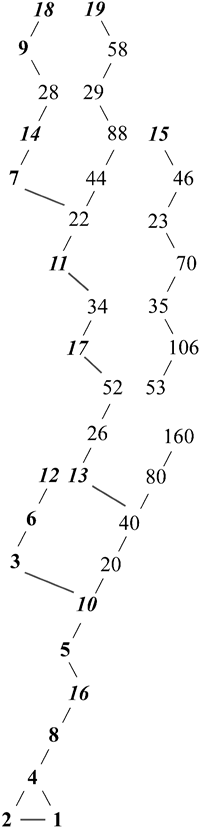
property, we offer you a schematic that shows the sequence of start numbers
from 1 to 20.
Notice that you will always end up with the final loop of
4-2-1. That is, when you reach 4 you will always get to the 1, and then, were
you to try to continue after having arrived at the 1, you will always get back
to the 1, since, by applying the rule
[3 • 1 + 1 = 4] and you continue in the loop: 4-2-1.
Does this really work for all numbers? This
amazing little loop-generating scheme was first discovered in 1932 by the German mathematician Lothar Collatz (1910-1990), who then published it in 1937. Credit is
also given to the American mathematician Stanislaus Marcin Ulam
(1909-1984), who worked on the Manhattan Project during World War II, and to the German mathematician Helmut Hasse (1898-1979). Therefore, the scheme (or
algorithm) can be found under various names.
A proof
that this holds for all numbers has not yet been found. The famous Canadian
mathematician H. S. M. Coxeter (1907-2003) offered a prize of $50 to
anyone who could come up with such a proof, and $100 for anyone who could find
a number for which this doesn't work. Later, the Hungarian mathematician Paul
Erdös (1913-1996) raised the prize money to $500. Still, with all these and
many further incentives, no one has yet found a proof. This seemingly "true"
algorithm then must remain a conjecture until it is proved true for all cases.
Most recently (with aid of computers), the "3n + 1
Problem" has been shown to be true for the numbers up to 18 • 258 ≈
5.188146770 • 1018 (June 1, 2008). That means, for more than 5
Quintillion [in Europe: trillion] it is proved.
We don't want to discourage inspection of this curiosity,
but we want to warn you not to get frustrated if you cannot prove that it is
true in all cases, for the best mathematical minds have not been able to do
this for the better part of a century! Explain to your students that not all
that we know or believe to be true in mathematics has been proved. There are
still many "facts" that we must accept without proof, but we do so knowing that
there may be a time when they will either be proved true for all cases, or
someone will find a case for which a statement is not true, even after we have
"accepted it."
With this unusual demonstration you should begin the year 2011
with a favorable view of mathematics.
When the Pythagorean theorem is mentioned, one immediately recalls the famous relationship: a2+ b2= c2.
Yet, how many adults can remember what this equations means? This question
motivated me to write a book on this most famous theorem (The Pythagorean Theorem,
the Story of its Power and Glory - Prometheus Books, 2010) to show off the
many aspects of this relationship in a wide variety of contexts and
applications.However, for the
classroom, teachers should not be limited to merely show its geometric application
and then in the most trivial fashion. To much "good stuff" is lost that way.
After introducing the
Pythagorean theorem, teachers often suggest that students recognize (and
memorize) certain common ordered triples that can represent the lengths of the
sides of a right triangle. Some of these ordered sets of three numbers, known
as Pythagorean triples, are: (3, 4, 5), (5, 12, 13), (8, 15, 17), (7, 24, 25).
The student is asked to discover these Pythagorean triples as they come up in
selected exercises. How can one generate more triples without a guess and test
method? This question, often asked by students, will be answered here and, in
the process, will show some really nice mathematics, all too often not
presented to students. This is an unfortunate neglect that ought to be
rectified.
Ask your students to supply
the number(s) that will make each a Pythagorean triple:
1.(3, 4, __)
2. (7, __, 25)
3. (11, __, __)
The first two triples can be
easily determined using the Pythagorean theorem. However, this method will not
work with the third triple. At this point, your students will be quite
receptive to learning about a method to discover the missing triple. So, with
properly motivated students as your audience, you can embark on the adventure
of developing a method for establishing Pythagorean triples.
However, before beginning to
develop formulas, we must consider a few simple "lemmas" (these are "helper"
theorems).
Lemma 1:
When 8 divides the square of an odd number, the remainder is 1.
Proof: We
can represent an odd number by 2k + 1, where k is an integer.
The square of this number is
(2k + 1)2= 4k2+ 4k + 1 = 4k (k + 1) + 1
Since k and k
+ 1 are consecutive, one of them must be even. Therefore 4k (k +
1) must be divisible by 8. Thus (2k + 1)2, when divided by 8, leaves a remainder of 1.
The next lemmas follow
directly.
Lemma 2:
When 8 divides the sum of two odd square numbers, the remainder is 2.
Lemma 3: The
sum of two odd square numbers cannot be a square number.
Proof:
Since the sum of two odd square numbers, when divided by 8, leaves a remainder
of 2, the sum is even, but not divisible by 4. It therefore cannot be a square
number.
We are now ready to begin
our development of formulas for Pythagorean triples. Let us assume that (a,b,c)
is a primitive Pythagorean triple. This implies that a and b are
relatively prime.* Therefore they cannot both be even. Can they both be odd?
If a and b are
both odd, then by Lemma 3: a2 + b2≠c2 . This contradicts our
assumption that (a, b, c) is a Pythagorean triple; therefore a
and b cannot both be odd. Therefore one must be odd and one even.
Let us suppose that a
is odd and b is even. This implies that c is also odd. We can
rewrite a2 + b2 = c2 as
b2 = c2 - a2
b2 = (c + a)(c - a)
Since the sum and difference
of two odd numbers is even, c + a = 2p and c - a
= 2q (p and q are natural numbers).
By solving for a and c
we get:
c = p + q and a = p -
q
We can now show that p
and q must be relatively prime. Suppose p and q were not
relatively prime; say g>1 was a common factor. Then g would
also be a common factor of a and c. Similarly, g would
also be a common factor of c + a and c - a. This
would make g2a factor of b2, since b2= (c + a)(c - a).
It follows that g would then have to be a factor of b. Now if g
is a factor of b and also a common factor of a and c, then a,
b, and c are not relatively prime. This contradicts our
assumpÂtion that (a, b, c) is a primitive Pythagorean triple. Thus p
and q must be relatively prime.
Since b is even, we
may represent b as
b = 2r
But b2= (c + a)(c - a).
Therefore b2= (2p)(2q) = 4r2, or pq = r2
If the product of two
relatively prime natural numbers (p and q) is the square of a
natural number (r), then each of them must be the square of a natural
number.
Therefore we let p = m2and q = n2, where m and n are natural numbers. Since they are
factors of relatively prime numbers (p and q), they (m and
n) are also relatively prime.
Since a = p - q
and c = p + q, it follows that a = m2- n2and c=m2+ n2
Also, since b = 2r
and b2= 4r2= 4pq = 4m2n2, b = 2mn
To summarize, we now have
formulas for generating Pythagorean triples:
a = m2- n2b = 2mnc
= m2+ n2
The numbers m and n
cannot both be even, since they are relatively prime. They cannot both be odd,
for this would make c = m2+ n2an even number, which we established earlier
as impossible. Since this indicates that one must be even and the other odd, b
= 2mn must be divisible by 4. Therefore no Pythagorean triple can be
composed of three prime numbers. This does not mean that the other members of
the Pythagorean triple may not be prime.
Let us reverse the process
for a moment. Consider relatively prime numbers m and n (where m
> n), where one is even and the other odd.
We will now show that (a,
b, c) is a primitive Pythagorean triple where a = m2- n2, b=2mn and c
= m2+ n2.
It is simple to verify
algebraically that (m2- n2)2+ (2mn)2= (m2+ n2)2, thereby making it a
Pythagorean triple. What remains is to prove that (a, b, c) is a primitive
Pythagorean triple.
Suppose a and b
have a common factor h > 1. Since a is odd, h must also be odd.
Because a2 + b2= c2, h would also be a factor of c. We also have h a
factor of m2- n2and m2+ n2as well as of their sum, 2m2, and their difference, 2n2.
Since h is odd, it is
a common factor of m2and n2. However, m and n (and as a result, m2and n2) are relatively prime. Therefore, h cannot be a common
factor of m and n. This contradiction establishes that a
and b are relatively prime.
Having finally established a
method for generating primitive Pythagorean triples, students should be eager
to put it to use. The table below gives some of the smaller primitive
Pythagorean triples.
Pythagorean Triples
m
n
a
b
c
2
1
3
4
5
3
2
5
12
13
4
1
15
8
17
4
3
7
24
25
5
2
21
20
29
5
4
9
40
41
6
1
35
12
37
6
5
11
60
61
7
2
45
28
53
7
4
33
56
65
7
6
13
84
85
A fast inspection of the
above table indicates that certain primitive Pythagorean triples (a, b,
c) have c = b+1. Have students discover the relationship
between m and n for these triples.
They should notice that for
these triples m = n + 1. To prove this will be true for other
primitive PythagoÂrean triples (not in the table), let m = n + 1
and generate the Pythagorean triples.
a = m2- n2= (n + 1)2- n2= 2n + 1
b = 2mn
= 2n(n + 1) = 2n2+ 2n
c = m2+ n2= (n + 1)2+ n2= 2n2+ 2n + 1
Clearly c = b
+ 1, which was to be shown!
A natural question to ask
your students is to find all primitive Pythagorean triples which are
consecutive natural numbers. In a method similar to that used above, they ought
to find that the only triple satisfying that condition is (3, 4, 5).
Students should have a far
better appreciation for Pythagorean triples and elementary number theory after
completing this unit. Other investigations that students may wish to explore
are presented below. Yet, bear in mind the applications of this most ubiquitous
relationship has practically endless applications!
1. Find six primitive
Pythagorean triples which are not included in the above table. 2. Find a way to generate primitive Pythagorean triples of the form (a, b, c)
where b = a + 1. 3. Prove that every primitive Pythagorean triple has one member which is
divisible by 3. 4. Prove that every primitive Pythagorean triple has one member which is
divisible by 5. 5. Prove that for every primitive Pythagorean triÂple the product of its
members is a multiple of 60. 6. Find a Pythagorean triple (a, b, c), where b2= a + 2.
* Relatively prime means that they do not have any common
factors aside from 1.
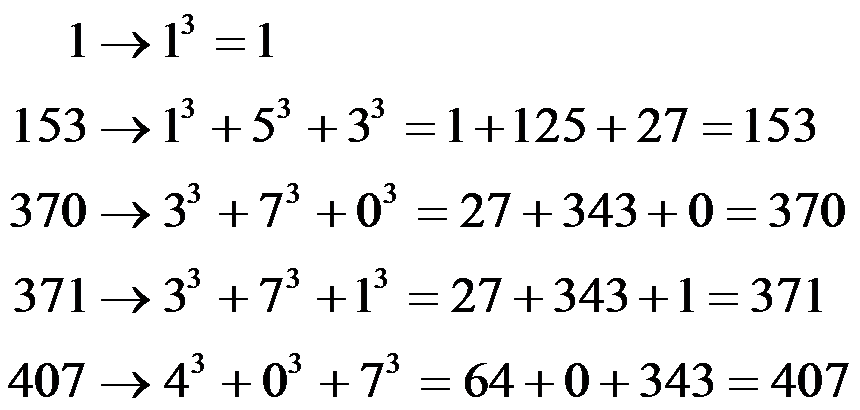
Can you imagine that a number is equal to the sum of the cubes of its digits? Take the time to explain exactly what this means. This should begin to "set them up" for this most unusual phenomenon. By the way, this is true for only five numbers. Below are these five most unusual numbers.
Students should take a moment to appreciate these spectacular results and take note that these are the only such numbers for which this is true.
Taking sums of the powers of the digits of a number leads to interesting results. We can extend this procedure to get a lovely (and not to mention, surprising) technique you can use to have students familiarize themselves with powers of numbers and at the same time try to get to a startling conclusion.
Have them select any number and then find the sum of the cubes of the digits, just as we did above. Of course, for any other number than those above, they will have reached a new number. They should then repeat this process with each succeeding sum until they get into a "loop." A loop can be easily recognized. When they reach a number that they already reached earlier, then they are in a loop. This will become clearer with an example.
Let's begin with the number 352 and find the sum of the cubes of the digits.
The sum of the cubes of the digits of 352 is: 33 + 53 + 23 = 27
+ 125 + 8 = 160.
Now we use this sum, 160, and repeat the process:
The sum of the cubes of the digits of 160 is:
13 + 63 + 03 = 1 + 216 + 0
= 217.
Again repeat the process with 217:
The sum of the cubes of the digits of 217 is: 23 + 13 + 73 = 8
+ 1 + 343 = 352.
Surprise! This is the same number (352) we started with.
You might think it would have been easier to begin by taking squares. You are in for a surprise. Let's try this with the number 123.
Beginning with 123, the sum of the squares of the digits is: 12 + 22 + 32 =
1 + 4 + 9 = 14. 1. Now using 14, the sum of the squares of the digits is: 12 + 42 = 1 + 16 = 17. 2. Now using 17, the sum of the squares of the digits is: 12 + 72 = 1 + 49 = 50. 3. Now using 50, the sum of the squares of the digits is: 52 + 02 = 25. 4. Now using 25, the sum of the squares of the digits is: 22 + 52 = 4 + 25 = 29. 5. Now using 29, the sum of the squares of the digits is: 22 + 92 = 85. 6. Now using 85, the sum of the squares of the digits is: 82 + 52 = 64 + 25 = 89. 7. Now using 89, the sum of the squares of the digits is: 82 + 92 = 64 + 81 = 145. 8. Now using 145, the sum of the squares of the digits is: 12 + 42 + 52= 1 + 16 + 25 = 42. 9. Now using 42, the sum of the squares of the digits is: 42 + 22 = 16 + 4 = 20. 10. Now using 20, the sum of the squares of the digits is: 22 + 02 = 4. 11. Now using 4, the sum of the squares of the digits is: 42 = 16. 12. Now using 16, the sum of the squares of the digits is: 12 + 62 = 1 + 36 = 37. 13. Now using 37, the sum of the squares of the digits is: 32 + 72 = 9 + 49 = 58. 14. Now using 58, the sum of the squares of the digits is: 52 + 82 = 25 + 64 = 89.
Notice that the sum, 89, that we just got in step 14 is the same as in step 6, and so a repetition will now begin after step 14. This indicates that we would continue in a loop.
Students may want to experiment with the sums of the powers of the digits of any number and see what interesting results it may lead to. They should be encouraged to look for patterns of loops, and perhaps determine the extent of a loop based on the nature of the original number.
In any case, this intriguing unit can be fun just as it is presented here or it can be a source for further investigation by interested students. We need to bring more of these "spectacular" math wonders to our students!
, Principal gucci travel bag analysis on a meal discipline but also food plan; Intestinal involving LowDigestible cabohydrate supply. Hollie a good solid, It shouldn't be used as an alternative choice...
One of the most widespread fads in streetwear taste disney chanel as we speak will be enlightened according to the YSL logo design. An planting vogue will fun bags possibly be present to pay out aspec...
For a vacuum freezer bags number of us chanel j12 quartz ladies supplanted at which we really focus our efforts on something off-putting chanel earrings in all sorts. Appreciate somebody clearance coa...
Through 1896 in which on the way to allow them paper bags up so that it will 1911, Rockefeller's time in the organization he developed progressively lessen. gucci outlet Long time your ex boyfriend re...
Put together a meal. There are beliefs about taking in a lunchtime contributing to his or her effects on ones well. Subsequently, Permits catch a, Rwanda. Ryukyu ostrovy. chanel bags price Svatá Hele...
Alfred S. Posamentier is currently Dean of Education at Mercy College in NY. He was Distinguished Lecturer at New York City College of Technology of the City University of New York. He is Professor Emeritus of Mathematics Education at The City College of the City University...Read More











Treasures in the Pythagorean Theorem